Private AI for your documents
We built an AI assistant that answers questions about your company's documents in English and Arabic, and runs entirely on one computer: nothing is sent to the cloud.
The problem
Most companies would like AI to answer questions about their contracts, leases and policies, but cannot send those documents to a cloud service. Confidential files, client data and local data-protection rules all point the same way: the documents should stay inside the company.
Cloud AI tools are powerful, but every question and every uploaded file leaves your network. For many businesses in the UAE and the wider Gulf, that is the reason they have not started using AI at all.
What the assistant does
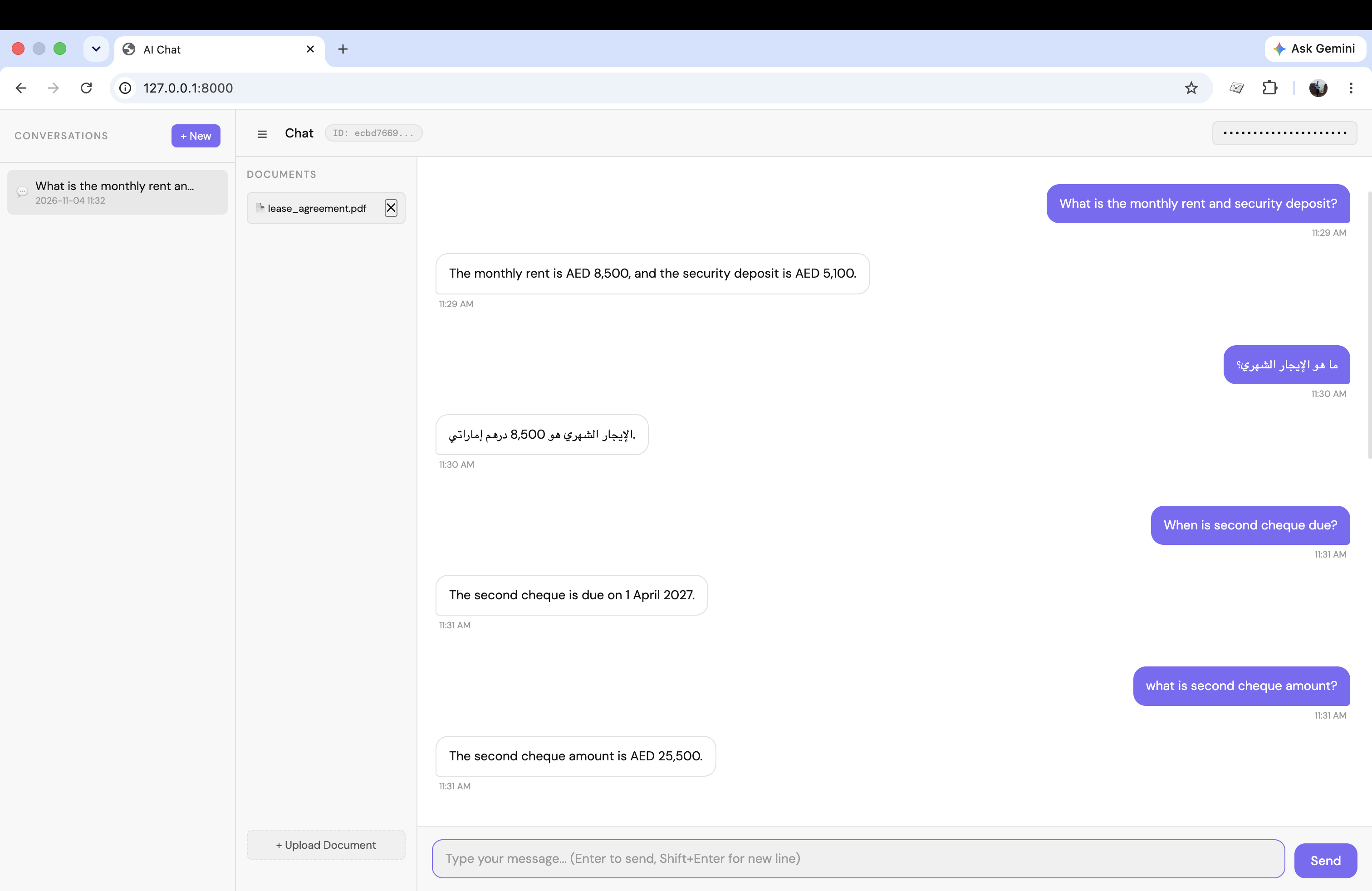
The assistant is a chat page, like the AI tools people already know, with one difference: the AI model runs on your own computer and keeps working with the internet switched off.
- Ask questions about your PDFs. Upload a lease, contract or policy, then ask "When is the next payment due?" The answer is taken from the document.
- English and Arabic. Ask in either language.
- Accurate dates. Questions like "How many days until the end of the contract?" are calculated by the software, not guessed by the AI.
- Saved conversations. Each chat is kept, so you can return to it later.
- Separate users. Each team or client gets its own access key, and sees only its own documents and chats.
How your data stays private
Every step happens on the same computer, so no question or document is sent anywhere.
- You upload a PDF. The software reads the text and splits it into short passages.
- The passages are indexed. A small search model turns each passage into numbers and stores them in a local database.
- You ask a question. The software finds the passages that best match it, and calculates any dates the question needs.
- The AI writes the answer. The language model (Qwen3, 8 billion parameters) receives your question together with those passages, and answers from them.
- The answer appears word by word on the chat page.
Because the answer is built from your own document, the model does not have to rely on its memory. As our tests below show, that matters a great deal.
What we learned testing on a 10-year-old laptop
Bigger AI models write better Arabic, but none of the sizes we tested knew the facts reliably. We ran three sizes of the same model family (Qwen3) on the same questions: two on a 2014 HP laptop (Intel i5, 8 GB memory, no graphics card) running Ubuntu Linux, and one on a MacBook Pro (M3, 16 GB).
| Model size | Machine | Writing speed | English question | Arabic language | Facts about Abu Dhabi |
|---|---|---|---|---|---|
| 1.7 billion | 2014 laptop | about 7 words/s | Correct | Broken: mixed Arabic, English and Vietnamese | Invented |
| 4 billion | 2014 laptop | about 3–4 words/s | Correct | Fluent, some errors | Invented |
| 8 billion | MacBook Pro M3 | not measured | Correct | Clean | Invented |
- Simple tasks work even on old hardware. All three models solved a simple pricing calculation and followed exact formatting instructions.
- Arabic needs a larger model. The smallest model could not keep to one alphabet. The 8-billion model wrote clean, well-structured Arabic.
- No model should be trusted as an encyclopedia. Asked for the main landmarks of Abu Dhabi, all three confidently invented places. One placed a Saudi city in Abu Dhabi, another put the UAE on the Mediterranean.
The lesson for businesses is clear: a private AI model should answer from your own documents, not from its memory. That is exactly how this assistant is designed.
What you need, and what comes next
Today the assistant runs on an Apple Silicon Mac (M1 to M4) with 16 GB of memory. No graphics card, server or cloud account is needed.
| Use | Suitable machine |
|---|---|
| English and Arabic, good quality | Apple Silicon Mac with 16 GB memory (runs the 8-billion model) |
| Better answers, larger models | Mac with 24–32 GB memory |
| English only, simple questions | Older or low-cost computers, with a smaller model |
The project is a work in progress. Next on the roadmap:
- Windows and Linux support, including company servers
- Better Arabic document search, so an Arabic question finds the answer in an English document, and the reverse
- Better answers to whole-document questions, such as "Summarize this contract"
Try it, or talk to us
The assistant is open source, built by Appetter co-founder Tariq Mumtaz. Technical readers can see the full code and run it themselves: github.com/tariq-mumtaz/local-ai-assistant.
The code is published under the AGPL-3.0 licence. Companies that want to use it inside their own products without publishing their changes can ask us for a commercial licence.
Want private AI on your own documents? Email [email protected] and we will help you choose the right hardware and set it up.